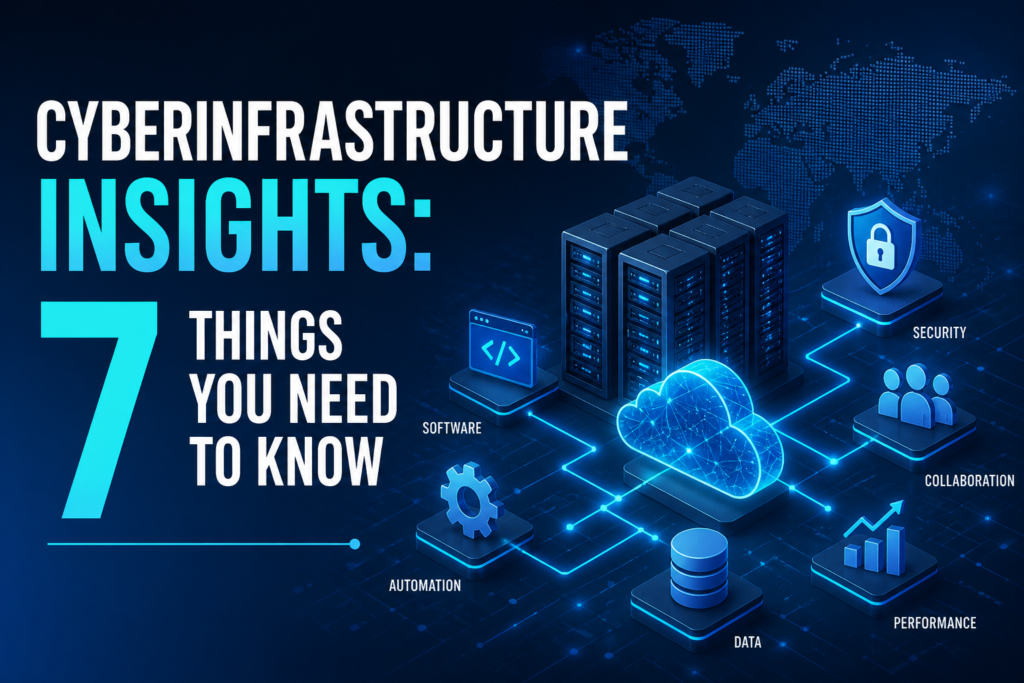
This article is about Cyberinfrastructure and the 7 things that you need to know about it.
In recent times, the demand for cyberinfrastructure has increased. This has also become a crucial part of research and scientific research. As there is a constant development in natural and engineered systems, an increased amount of data is generated from various industries. There is also a growing demand for simulation, experiments and observations. Computers are used for analysing data at a faster rate, as they have the ability to scan through a large chunk of data in less time. Making progress in less time for many domains. This is only possible because of the advancement in technology, computers, and systems used by the industries in research.
What is Cyberinfrastructure?
Cyberinfrastructure is a set of technical devices like high-performance computers, remote sensors, large sets of data, and sophisticated applications that help understand complex programs and decode complex datasets. The infrastructure that all these facilities are part of is known as cyberinfrastructure. This is also known as e-research, e-science, and e-infrastructure in Europe and Asia. This system consists of advanced technology like data storage systems, advanced instruments, data repositories, and visualisation environments and people who are experts in these technologies. They are all connected with a high-speed network for seamless communication, and also make difficult innovations and discoveries possible. This term was first used by the US National Science Foundation (NSF) to describe advanced technology.
The main objective of this infrastructure is to provide access and use of an advanced information technology system in an easy way. It also helps generate new information and use tools, expertise, and facilities. In the US, many organisations like the US Department of Energy and NASA already have a plan to build cyberinfrastructure. This infrastructure can be useful to many sectors.
How Cyberinfrastructure Works?
Cyberinfrastructure depends on technical devices that knit together high-speed networks and high-performance computers. The usage of these devices is controlled by management systems. There is also a security system that protects these devices from threats. Data can be a collection of previously collected data or a live feed of data from the remote sensors that are located in different parts of the world. These systems are housed in different locations, and the experiments in these systems are run on “Virtual Machines”. These experiments are collected from dozens or hundreds of computers, which are used to perform a single experiment. This infrastructure can also become a data centre and distributors as they can collect different sets of data from different centres and send it to the centre that needs that data for further research work. They can also merge these datasets and help researchers study in more detail.
Significance of Cyberinfrastructure
The data that is collected from these infrastructures is archived and further analysed in detail. Due to this infrastructure processing, preserving and collecting a huge amount of data is made possible. Researchers have also been able to explore more topics that were previously never researched or studied. This has created new opportunities for researchers and also industries, as they can find new possibilities and products.
Through this, students and professionals can access a huge pile of information and study in detail about it, conduct research, and also discover something new. Geographic barriers are also diminished as they can connect with different organisations and brainstorm, discuss and learn about new ideas. This type of infrastructure is very significant for growth and development in an organisation and industry.
Who can use Cyberinfrastructure?
Students and professionals who want to research or gain information about different things can use cyberinfrastructure. Cyberinfrastructure can be used by industries and other areas that are not associated with science. Researchers can use CI to research complex and multidisciplinary problems. The information and data generated by this research are very valuable and can be preserved and used by other researchers in future. They have also become part of the virtual data centre that is created by these researchers, and sharing information is made easy. Researchers can use CI to study climate change and other complex issues that need to be addressed and also need an appropriate solution. Through CI, addressing and studying complex topics have been made easier.
Limitations of Cyberinfrastructure
This infrastructure processes and preserves a large amount of data and is also well-equipped with technologically advanced devices that have a high performance rate and are able to process complex problems. This type of infrastructure can only be made by financially strong organisations. This is not made for small-scale organisations. However, small-scale companies can contribute to this infrastructure by providing valuable information and connecting to it. There is also concern for security as more data attracts more threats and can be a centre for security breaches, like hacking and other ways to illegally extract data. There is also a constant need for maintenance of applications and devices that preserve the data.
Cyberinfrastructure’s Development
CI is in the development stage and is trying to improve its capacity, reliability and management. Though it is still used in research and science, it is also used in the humanities, arts, and education over time. In education, students can gain practical knowledge and also participate. Use of CI has become a global initiative. According to NSF, it is costly for an individual or a nation to develop. It has enabled international collaborations as they can share their set of information and tools with other countries and organisations. They can also become a global centre for a particular data set or can become community resources at a local or global scale.
What can Cyberinfrastructure do in Teaching and Learning?
Through cyberinfrastructures, now faculties can guide students to try their hands at learning new things as they can easily access notes and information about their subjects from larger and smaller institutions. Now, both large and small institutes can share their data through a virtual organisation. They can also participate in conferences and meetings as virtual team members and gain experience and learn new things from their team members and others. In CI, students can also get early access to the tools and participate in the development of the tools used in cyberinfrastructure. They can also run their own experiments using the information in the virtual organisation and learn and develop their skills. Universities can also give access to the data sets preserved in these infrastructures so that the students can procure knowledge and are also encouraged to find new possibilities in their respective fields. It can also help the faculty to get an update on new things and also insights about the current trending topics, tools, and methods, so that they can share them with students and also teach them about them.
Cyberinfrastructure is under development, but it can be a good way to develop technology in an area and a country. This can also be a useful way to train future students and also a way to gain experience from this technology in their respective fields. This technology is slowly developing and can act as a great tool to develop technology for a country ad also an opportunity for students to upgrade their skills. If this technology is used by a country or an organization the organization ca discover new possibilities and also upgrade their business. Students will also get an understanding of what the industries are using for their development and running their business efficiently.
If you want to know the difference and benefits of 5g and Satellite Internet Services give a read to our article.