Benefits and Challenges of Unsupervised Reinforcement Learning in Machine Learning
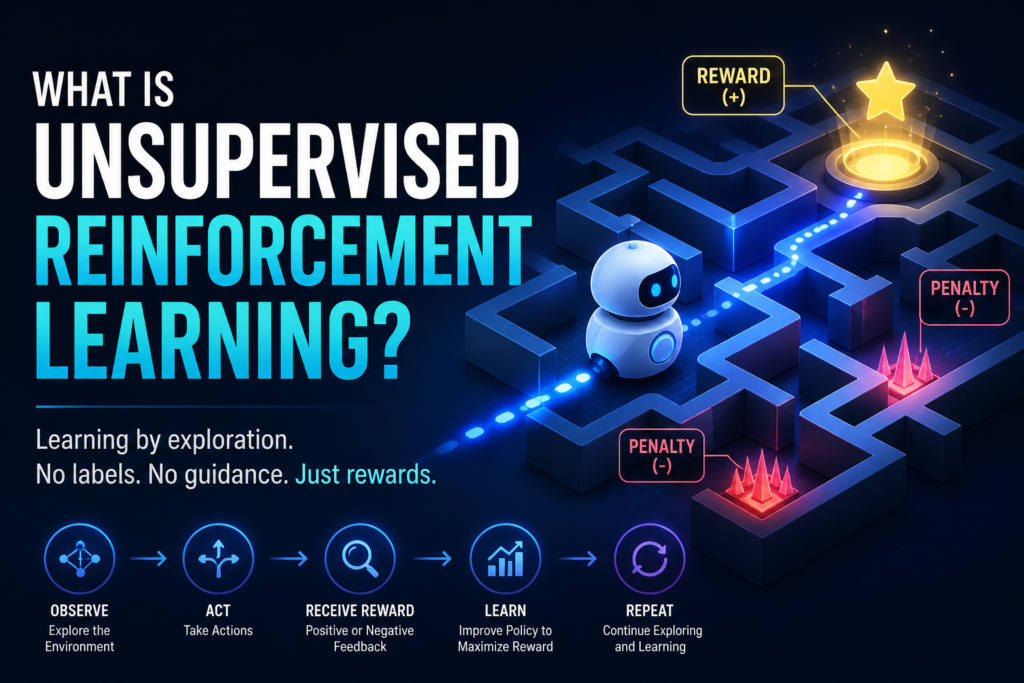
Unsupervised reinforcement learning combines unsupervised learning, where the machine finds solutions without supervision, and reinforcement learning, where learning happens from limited data. This approach allows AI to gather information and solutions using trial and error. More details are discussed in the following article.
How Does Unsupervised Reinforcement Learning Work?
Some AI algorithms use unsupervised reinforcement learning to give systems the freedom to learn new things and solve problems in different ways, often via trial-and-error or by predicting solution success. This approach uses a unique type of dataset.
In this type of machine learning, a machine considers its environment as a teacher and the solution as an intrinsic reward. Basically, the machine develops itself according to its environment and also gathers more data to develop and act accordingly.
If explained more thoroughly, then, when a machine’s algorithm is made in such a way that it will gather more information from its environment and give solutions by combining the old data and the new data which it has attained while in the environment. The data which is given to the machine is uncategorized, and the machines are made in such a way that they can categorise the data given.
This type of machine learning is also quite challenging, as it has its drawbacks. They are listed below:
- This type of machine learning program faces challenges in creating labels and annotations. The maintenance of these programs requires a lot of time and effort.
- Reward allocation is difficult as to what type of rewards will benefit the machine in what ways. Also, the rewards should be continuous.
- Collecting data on human behaviour is also challenging, as there is no specific annotation for it.
Reinforcement learning is generally used when a machine has to do a human’s work. So, unsupervised reinforcement learning is used to develop machines that can do human’s work to ensure that the machine can fully do what a human can do. Using both types of machine learning models can eradicate the drawbacks faced by both models and increase the productivity of a machine.
At the start of this article, we talked about how this type of machine learning is a combination of two machine learning techniques. So, to further elaborate on the same, this type of machine learning first uses unsupervised learning’s two basic divisions, which are generative and non-generative learning. Through these two models, it gathers and learns a large amount of data on how humans behave when reacting in a certain way. Once that is known, these models can be used to generate data to plan according to the behaviour. After planning is done, reinforcement learning is used to decide the reactions that will help the machine earn rewards.
In order to speed up the learning process, a non-generative model can be used as an external learning model. To ensure more efficiency of the machine, the use of a generative model of unsupervised learning can help a lot. The use of unsupervised learning in reinforcement learning can also speed up the learning process of a machine and save time.
With the combination of these two models of learning, a developer can create a high-value AI application that can solve complex problems in less time. Machines and applications created using these models are used in various research and development areas related to various industries across the world. AI apps that are created using this method are flexible and have a wider scope of addressing problems than apps that are created using a single model. The reason behind this is the drawback of each learning model.
Applications that use these types of learning models are used for self-driving cars, gaming, and healthcare purposes. This is not limited only to these fields, but also to fields that need continuous solutions to problems and also a human touch. Through this learning model, apps can adjust to any given environment, develop their own data set and react accordingly. The features of these two learning models enable the AI application and machine to explore and also exploit the environment to learn and gather new information about its environment. An unsupervised reinforcement learning model has a drawback in that after a certain limit, the same reaction occurs. This drawback will also be resolved shortly as the technology field develops. For decades, many tech giants and other giants of their field have used machines that are manufactured with the use of unsupervised reinforcement learning to complete their day-to-day tasks at various facilities that are involved in the production of their products or commencing their services to their consumers.
There is another model that can be used to develop AI applications. This model is known as a supervised learning method. In the supervised learning method, the machine needs human supervision under which it completes the given task. There can be a combination of supervised learning and reinforcement learning models to create applications and machines that can help improve the production rate of an organisation. There can also be a combination of all three types of learning models to create an application that is efficient in solving more problems that are much tougher for a machine or an application developed using an unsupervised reinforcement learning model.
As the demand for more interactive AI systems is growing there is a need to develop AI apps that are more efficient and effective in solving any kind of problem put in front of them. Therefore, the use of a learning model that trains the AI apps in a way that they can gather and adapt themselves in an environment is mandatory. Due to this requirement, unsupervised reinforcement learning of a machine or an AI has become necessary to curb complex problems put forward by people who will use this application. The technology of artificial intelligence will come into the hands of common people, who will probably be laypeople. The development of an application that can solve almost every problem is becoming mandatory work for developers to sell their applications at a good rate. An unsupervised reinforcement learning model is helping organisations to spend less on assigning human help to teach the machines their work. This has increased the production rate of the company and has lessened its expenses.
Conclusion
An unsupervised reinforcement learning model is a very helpful model for making applications that can cover more ground and also help companies increase their productivity. So far this all the things that are needed to be known about unsupervised reinforcement learning. There is more to find on how to teach a machine to complete and address a problem, and also to explore this model that will make the application more efficient.
You can read more about cybersecurity and the companies that protect enterprises.